Yesterday I was at an event where startups could pitch their past six months prototyping journey. The most frequent question from jury members was: how does the business become profitable?
The answer: “We don’t know. We just wanted to build something great.”
This starting point is nice. Every good company begins with someone who cares more about solving a problem, rather than the spreadsheet. But as an answer to that question, it fails, and I think explaining why is useful. I hear versions of it regularly, especially when the founders are technical, and it usually costs them more than they realise.
TL;DR. Profitability simply means that, over time, total revenue exceeds total costs. It is the condition for continuing to build, not a later-stage concern. The cheapest moment to design for it is the prototype, because that is where your cost structure and price ceiling get fixed. You don’t need a full financial model yet. You need honest answers to five questions:
- Who pays, and what do they pay for today?
- What does one unit cost you to deliver, now?
- What would a customer reasonably pay?
- What has to be true for the gap to be positive?
- How long can you run until you know?
Great is the beginning of the sentence
Building something great is an incentive. It isn’t a plan for survival.
The only way a business can survive is by consistently having more money coming in than going out. That is all profitability means: total revenue above total expenses. It’s the condition for continuing to build at all. A company that can’t cover its costs is on a countdown, however good the product is. The countdown just runs on someone else’s money: a grant, a founder’s savings, an investor’s patience. Another dose may keep the company alive, but it doesn’t make the business sustainable.
Not just an investor’s question
Founders often hear “how will you make money?” as an examination to pass. It’s better understood as a design constraint, and it serves you first. A better way to frame it is: This is the amount of money you have and these are the questions you can test in the market. What answers are you aiming for?
- If you want to build, it tells you what you can afford to build, and for how long.
- If you want to succeed, it forces the uncomfortable choices early: who pays, how much, and why them.
- If you want funding, it’s the first thing any serious funder tests, from venture funds and business angels to corporate partners and the EIC, whose evaluation weighs commercial potential alongside the technology.
Investors aren’t looking for a founder who has every number right (numbers are always wrong anyway). They are looking for someone who knows which numbers matter and has a view on how to judge and validate them.
It starts at the prototype, not at scale
Deeptech and spin-off teams believe that profitability is a problem for later: first prove the technology, then worry about the business.
The prototype stage is when you can still make expensive mistakes cheaply. Decisions about what to build, for whom, and how much it will cost to deliver shape your business long before it starts generating revenue. Get them wrong, and even a brilliant product can become impossible to sell profitably.
Instead, you need honest answers to five questions:
- Who pays, and what do they pay for today? If nobody pays to solve this problem now, be careful about assuming they’ll pay for your solution later.
- What does one unit cost to deliver? Today, not at scale, including materials, labour, overheads, and your own time at a realistic rate.
- What would a customer reasonably pay? Ask with a number on the table. Compliments cost nothing; prices give information.
- What has to be true for each sale to be profitable? Write it down. Those are your real, testable hypotheses: assumptions about costs, pricing, demand, and margins that you need to validate.
- How long can you run until you know? Your runway is the budget you have for finding out whether the business can work.
“We don’t know yet” is a fine answer to any of these at the prototype stage, as long as you have a plan to find out.
Grants are runway, not revenue
For European science-led founders, this one matters most. Horizon Europe, the EIC and regional programmes can fund the years a deeptech company spends without profit. But they buy time; they don’t replace a business model. The same goes for an equity round. Treat both as the budget for answering the five questions.
Day to day
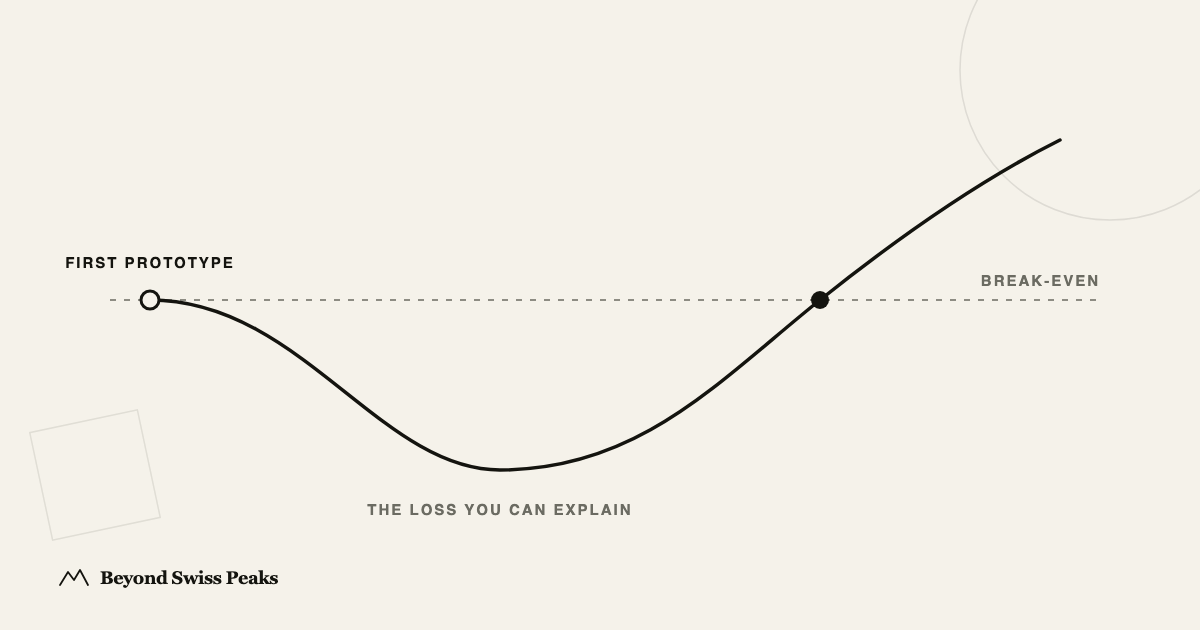
Keeping profitability in mind doesn’t mean optimising margin from day one. Many good companies lose money for years on purpose. It means you can always explain the loss: what you’re buying with it, and what has to happen for it to turn.
- Know your unit economics, even roughly, and update them as you learn.
- Test pricing early. A free pilot teaches you far less about willingness to pay than a paid one.
- Treat grants and investment as time bought, not revenue earned.
- Review costs against revenue every month, not just when cash gets tight.
- Practise explaining your path to profitability until the story is short and specific.
The better answer
Same question, different answer (or what I’d reply):
“We don’t have the full picture yet, but here’s what we know. Each unit costs us this much to deliver. Our first three pilot customers were willing to pay within this range. We break even at roughly this sales volume, and over the next six months, we’ll test whether we can reach it.”
That founder hasn’t solved profitability. But they’ve shown they’re building something great and taking responsibility for keeping it alive. Investors back that combination. Customers and employees tend to trust it, too.
The take-home
Building something great is one of the best reasons to start. It isn’t a reason to skip the question of how it will pay for itself. Keep that question in mind from the first prototype, and your ambition gets a much better chance of lasting long enough to matter.
Frequently asked questions
When should a startup start thinking about profitability?
From the first prototype. That is where your cost structure and price ceiling get fixed, through choices about what to build, for whom, with which materials and at what complexity. You don't need a full financial model yet, but you do need honest answers on who pays, what one unit costs, what a customer would pay, and how long your runway lasts.
What are unit economics at the prototype stage?
Unit economics compare what one unit of your offer costs to deliver today (materials, delivery, and your own time at a realistic rate) with what a customer would reasonably pay for it. The difference is what each unit contributes towards fixed costs. Early on the numbers are rough, but writing them down turns them into testable hypotheses.
Do grants count as revenue for a startup?
No. Grants such as Horizon Europe or EIC funding, like equity investment, buy time: they extend the runway. They don't replace a business model or prove that customers will pay more than delivery costs.
How should a founder answer “how will you become profitable?” in a pitch?
Say what you know and what you are testing: the cost to deliver one unit, the price range early customers indicated, the rough break-even volume, and what the next months will prove. Juries and investors don't expect every number to be right. They expect you to know which numbers matter.
Further Reading
- Great science isn't a startup. The four commercial instincts most university spin-offs are born without, including the grant-funding trap.
- Value Proposition Canvas, properly done. How to find out who your customer is and what they would pay for, before you set a price.