Most companies cannot explain, in one clean sentence, why anyone should buy from them. Not because the founders are unclear thinkers, but because they describe what they built instead of what the customer is trying to do. The gap between those two things is where deals quietly die, and it's exactly the gap a value proposition canvas is meant to close.
TL;DR. The value proposition canvas maps what your customer needs against what you offer. Most people fill it in badly: sticky notes reward guessing, and a generic AI just flatters you. This guide gives you a guarded chain of nine AI prompts that builds the canvas customer-first, challenges your assumptions, and hands you a reusable document plus a list of what to go validate.
This guide shows you how to write a value proposition canvas properly, and how to do it with AI without getting the generic, flattering answer a chatbot usually gives. The Value Proposition Canvas is the best tool I know for the job. But the way most people fill it in (a wall of sticky notes in a two-hour workshop) wastes most of its power. The method here is different: a chain of 6+3 AI prompts that walks you through the canvas in the right order, keeps the customer firmly at the centre, and holds your own assumptions up to the light. Whether you're writing a value proposition from scratch or trying to improve one you already have, the chain is built to make it sharper.
If you've never heard of a value proposition canvas, start here anyway. The first half of this guide explains the whole thing from scratch. If you already know it, skip to “Why the usual way fails.”
Read this first if you're very early. This method produces hypotheses to test, not answers. If you have spoken to zero real customers so far, the canvas you build will be a confident fiction assembled entirely from your own head, and a polished fiction is more dangerous than an empty page, because it feels like proof.
For you, the single most valuable output of this whole chain is not the canvas. It's the list of open questions it generates at the end: the things you now need to go ask a real person. Run the chain, then treat its output as your interview shopping list. Do not treat it as your value proposition until a critical mass of potential customers has told you it's true.
Part 1. What a value proposition canvas actually is
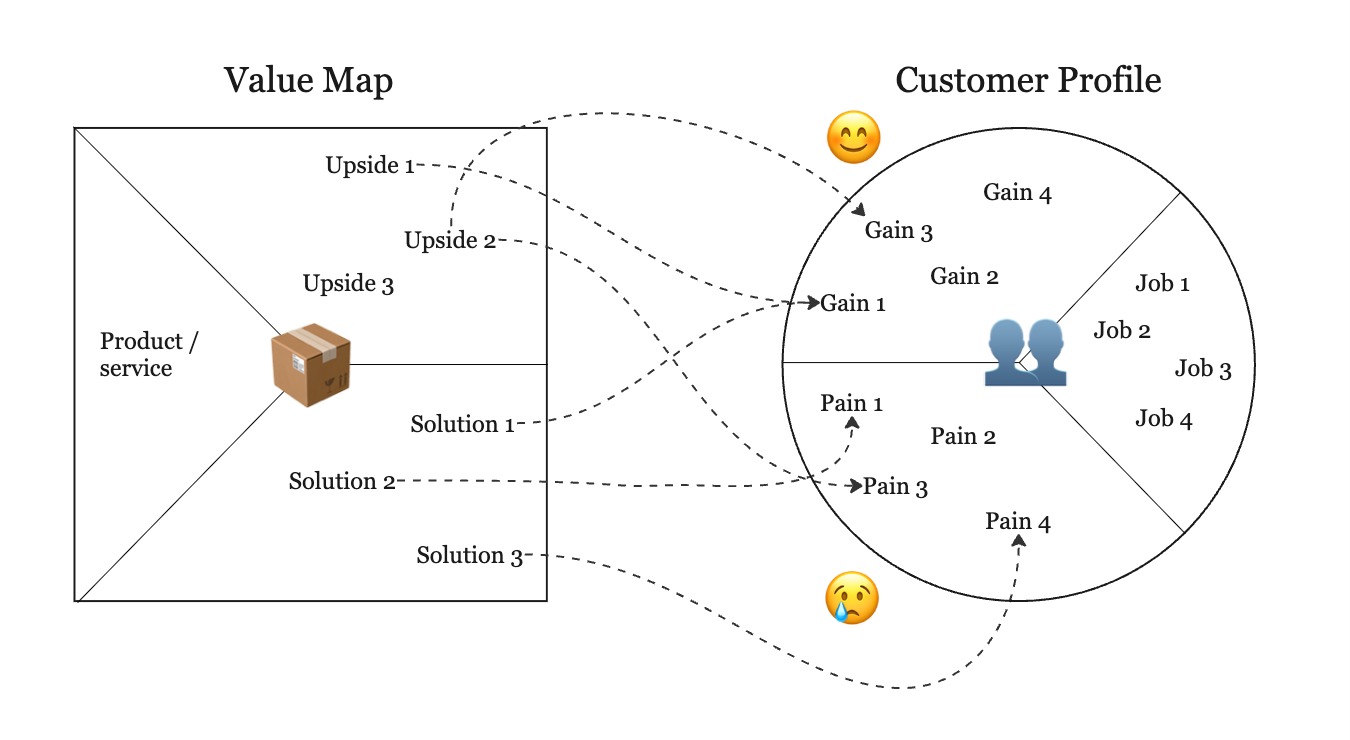
The canvas, created by Alexander Osterwalder and the Strategyzer team, has two halves that you build separately and then check against each other.
The customer profile describes the customer you're serving, independent of whatever you sell. It has three sections:
- Jobs: what your customer is trying to get done. Not just practical tasks (“file my taxes”) but social ones (“look competent to my boss”) and emotional ones (“stop feeling anxious about report”). People rarely buy a product; they hire it to do a job.
- Pains: the frustrations, obstacles, risks, and bad outcomes they experience while trying to get those jobs done. What wastes their time, costs them money, keeps them up at night.
- Gains: the outcomes and benefits they want. Some are basic expectations; some are things they'd love but don't expect; some they haven't even articulated yet.
The value map describes what you offer, and it mirrors the customer profile. It also has three sections:
- Products & services: what you actually provide.
- Pain relievers (Solutions): how your offer removes or reduces specific customer pains.
- Gain creators (Upsides): how your offer produces specific customer gains.
The whole point is the relationship between the two halves. You have fit when your pain relievers address pains the customer genuinely has, and your gain creators produce gains the customer genuinely wants. No fit means you've built something nobody is hiring for the job.
That's the entire framework. It's simple on purpose.
The difficulty is never understanding it, it's filling it in honestly.
Part 2. Why the usual way to write a value proposition fails
Three failure modes show up again and again, and they're worth naming because the method in this guide is designed specifically to prevent each one.
The Post-it wall rewards quantity over honesty. A sticky note costs nothing to write, so the wall fills with plausible-sounding pains and gains nobody has pressure-tested. Volume feels like progress. It isn't.
It blurs the three sections together. Jobs, pains, and gains are genuinely different, but in a fast workshop they collapse into one undifferentiated list of “stuff the customer wants.” The distinction that makes the canvas useful is the first thing lost.
It lets you describe your solution instead of your customer. This is the deepest one. Technical founders instinctively map what they built rather than what the customer is trying to do. The canvas becomes a feature list wearing a strategy costume.
Now, the obvious modern shortcut: open a generic AI assistant and ask it to “fill in a value proposition canvas for my startup.” You'll get a clean, confident, completely generic answer. The model has no real context about your segment, no guardrail against your biases, and no instruction to challenge anything you say. It reflects your own language back at you in tidier formatting. That's not rigour, it's flattery with bullet points.
Part 3. The method: writing your value proposition with a guarded AI prompt chain
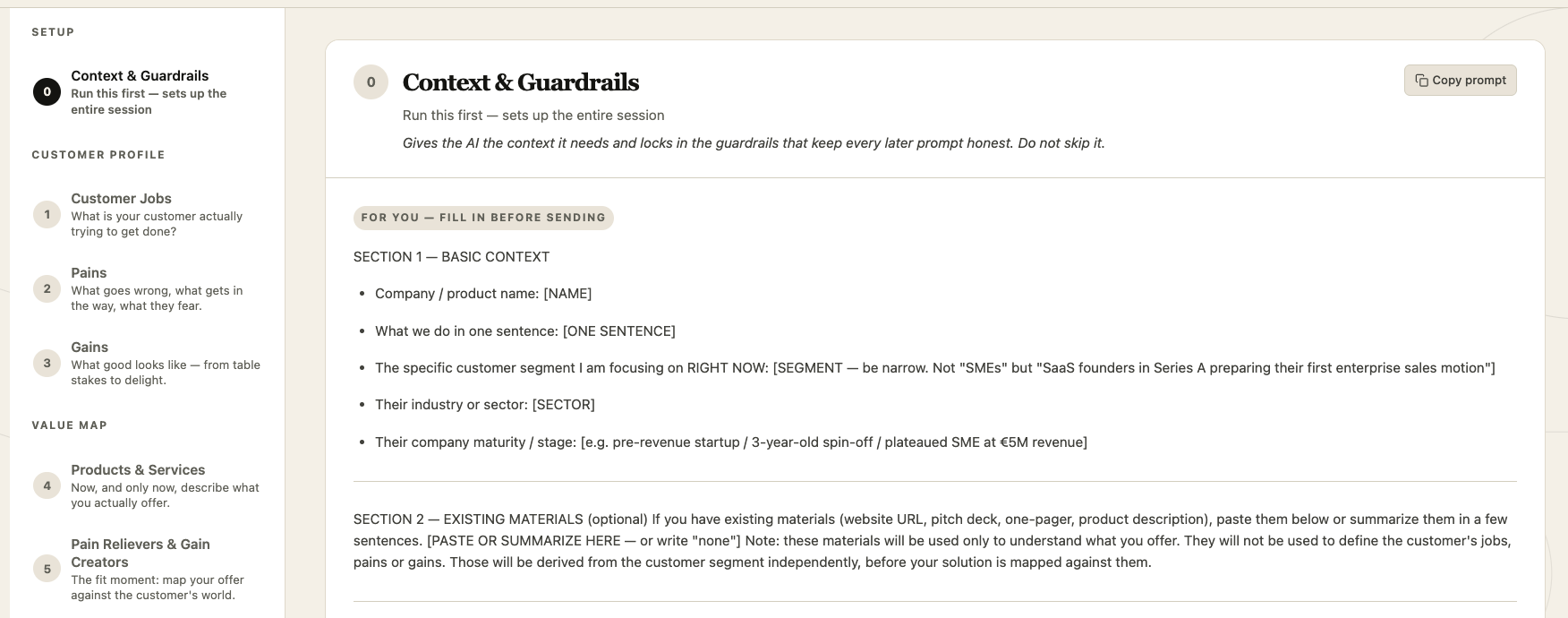
The fix is a chain of prompts, run in order, in a single AI conversation. Each prompt does one job and feeds the next. Five design ideas make it work, and understanding them is what lets you trust the output instead of just pasting it.
1. Context first, and only once. The opening prompt establishes who the customer is, what stage they're at, and critically who pays versus who uses. That last distinction quietly resolves the B2C/B2B confusion that derails so many young companies: founders who think they sell to consumers but actually sell to institutions and businesses, and the reverse. The narrower the segment you commit to here, the sharper everything downstream becomes. More detailed segmentation will always lead to more detailed set of valuable questions.
2. Guardrails that persist. The opening prompt also installs standing instructions that govern the entire session: derive the customer's world from the segment, not from the founder's pitch; never assume the current product is the best answer; flag it whenever the founder describes a need in solution terms. Because everything in one conversation stays in context, these rules apply to every later step. This is the single biggest difference from a generic AI chat. The guardrails are the strategy.
3. One prompt, one job. Jobs, then pains, then gains, each handled separately, each forced to stay in its lane. The chain structurally refuses to let you collapse the three sections. The discipline the workshop loses is built into the sequence.
4. Your knowledge gets pulled in, then challenged. Each customer-side prompt opens with a short diagnostic you fill in an analogy (“it's like X but for Y”), the exact words a customer used to complain, your own frustration if you built this because you had the problem too. This matters especially for inventor-founders, who are often a real source of insight about the pain. The chain takes that insight seriously, then labels it as a hypothesis to validate rather than letting it pass as fact.
5. The output outlives the workshop. In a typical Value Proposition workshop, the insight lives on sticky notes or a slide that gets archived after the session and rarely opened again. Here, the canvas is a structured document you keep and reuse. Paste it into your next conversation and it becomes the starting context for customer discovery calls, messaging and marketing, business model iteration, or partnership conversations. You are not starting from zero each time you touch a new piece of the business. The canvas becomes your working memory for that segment.
Part 4. Walking through the nine prompts
Here's what each step produces and why it's placed where it is.
Context
Prompt 0. Context & Guardrails. You define the segment, optionally paste your existing materials, clarify who pays versus who uses, and the standing guardrails get installed. The AI asks one clarifying question and produces nothing else. Resist the urge to skip this; it's the spine of everything after.
Customer Profile
Prompt 1. Customer Jobs. You answer two quick diagnostics (the analogy test and the dinner-table test), and the AI maps functional, social, and emotional jobs in the customer's own voice. The social and emotional jobs are the ones founders skip (and often the most powerful).
Prompt 2. Pains. Five diagnostics surface what genuinely hurts, including the “founder mirror” test for founders who built the product to solve their own problem. The AI rates each pain CRITICAL, SIGNIFICANT, or MINOR. Severity labels stop the canvas from becoming a flat list.
Prompt 3. Gains. The AI sorts gains into four tiers: required, expected, desired, unexpected. This is where most companies discover they only compete on the bottom two tiers, which are table stakes, not differentiation.
Value Map
Prompt 4. Products & Services. Now you describe what you offer. The “technical temptation check” catches feature-speak and forces every item into customer-outcome language. Anything that maps to no customer job gets flagged.
Prompt 5. Pain Relievers & Gain Creators. The fit moment. Most canvases treat these as two separate exercises; here they're deliberately run together, because separating them tempts you to inventory your features instead of asking, line by line, whether this specific pain actually goes away. Your offer is mapped against the customer's pains and gains in two tables. The critical pains you don't relieve (gaps) get flagged explicitly. If your whole offer only addresses table-stakes gains, the chain says so out loud.
Fit & Calibration
Prompt 6. Fit Assessment. The AI rates your problem-solution fit, compresses everything into one honest value-proposition sentence, and then immediately turns you toward the customer: it names the three assumptions most important to validate and most likely to be wrong, and writes a specific, non-leading interview question for each. If you've spoken to few or no customers, it says so plainly, the canvas is provisional, and this validation list is your real takeaway.
Prompt 7. Stress Test. A skeptical investor asks the five hardest questions your canvas raises. You end with your own weakest points named for you, which is exactly what you want before talking to real customers (and invesotors down the road).
Prompt 8. Export Summary Document. The chain produces a portable summary document, a clean file capturing the whole canvas, the fit score, the validation plan, the stress-test questions, your open questions, and instructions for reusing it as input in future sessions. This is the artifact you save and come back to.
Ready to build yours? Open the prompt chain →
Part 5. How to use it strategically
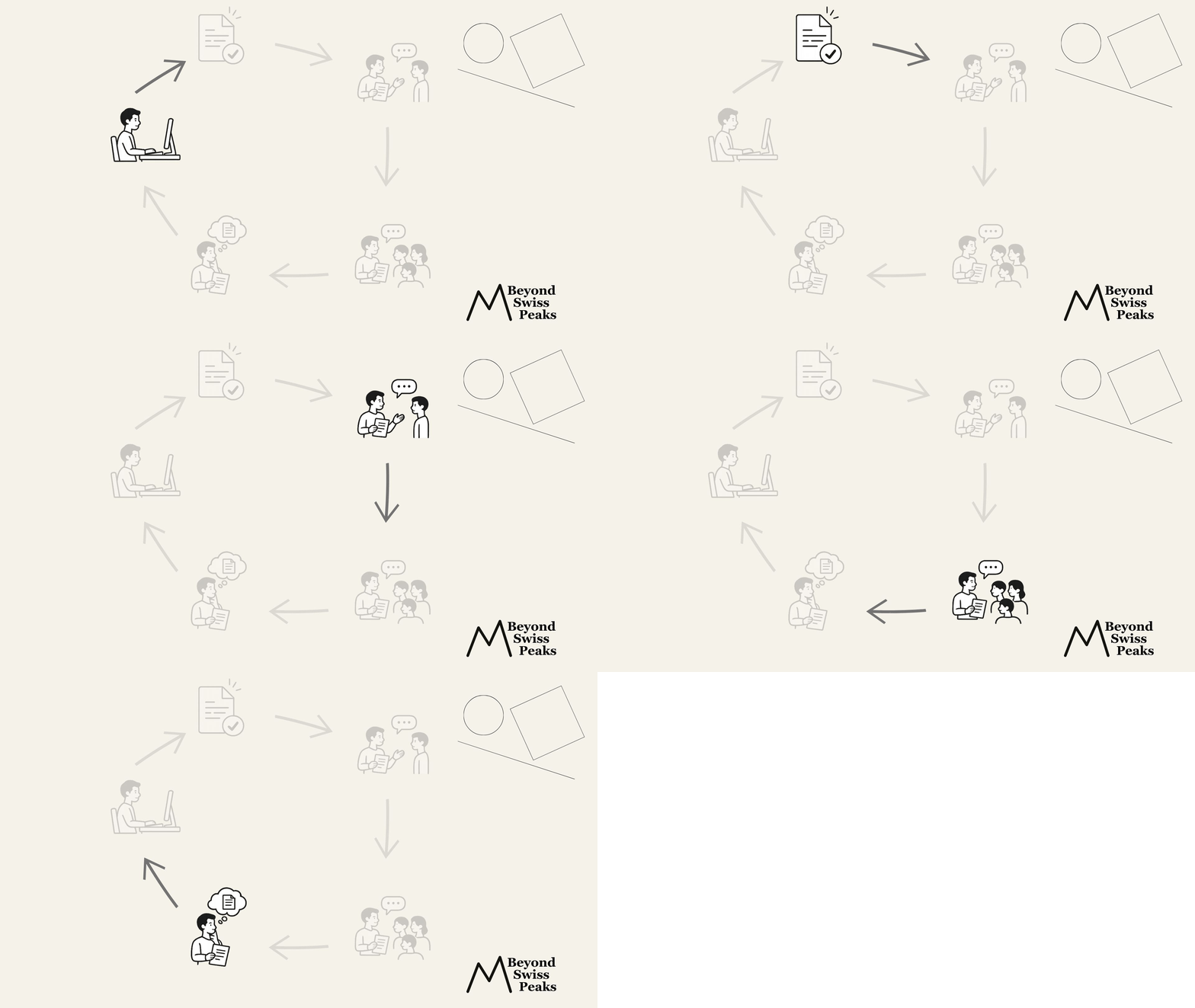
The chain produces a draft, not a verdict. Its real value is in how you iterate.
Run it once per segment, not once per company. A biotech spin-off and an agritech SME share almost nothing at the jobs-to-be-done level. Re-run the chain for each segment you serve. When the canvases diverge sharply, that's a signal they need different value propositions, possibly different products or services.
Re-run it across maturity stages. The same customer at year one and year three has different pains and different urgency. The context step makes stage explicit so you can hold the product constant and watch the canvas shift.
Treat the flags as your to-do list. Every gap, every “no job match,” every “competing on table stakes only” is a real strategic question. A critical pain with no reliever is either your next product priority or your next partnership.
Already have a value proposition? Use the chain to improve it. You don't have to start from a blank page. If you already have a value proposition, a website headline, a pitch-deck slide, a one-liner you've been using for months. Paste it into Prompt 0 as your existing material. The chain will then build the customer profile independently and map your current claim against it, which is the fastest way to improve a value proposition with AI: it shows you exactly which pains your existing wording addresses, which it misses, and where you're claiming a differentiator that's really a table-stakes gain. The output isn't a rewrite for its own sake, but a diagnosis of where your current value proposition is strong and where it leaks.
Take the summary document to real customers. Nothing here replaces talking to the people you serve. The chain's job is to make that conversation sharper. It gives you a structured set of hypotheses and your weakest claims, so that your interviews test what matters instead of wandering.
Match what you trust to what you've actually heard. Be honest about your evidence base when you read the output. If you've run dozens of customer conversations, the canvas is a structuring of real signal. Trust it more, and use it to find the patterns you missed. If you've run a handful, it's a draft to confirm. If you've run none, it's pure hypothesis: the canvas body is throwaway, and the open-questions list is the only part worth keeping. The chain doesn't know how much you've validated, only you do, so you have to supply that judgment.
Part 6. Where this method falls short
A guide you pin and revisit should be honest about its own limits. Here's where to be careful.
The output is only an hypotheses, (not data) and it's dangerously polished. The biggest risk is false confidence. A clean, well-formatted canvas feels validated even when every line is speculation. The guardrails reduce founder bias, but they cannot manufacture customer truth. Read the finished canvas as a list of things to test, never as things proven. The stress test and the “open questions” section exist precisely to keep you honest here.
Garbage in, garbage out (amplified). If you pick the wrong segment or describe it loosely, the chain doesn't correct you; it confidently builds an entire canvas on the bad foundation. The narrowness of your Prompt 0 segment determines the quality of everything else. Spend disproportionate effort there.
The diagnostics are real work. Filling in the tests for Prompts 1 through 5 takes genuine thought. Some users will be tempted to write “n/a” through them and let the AI invent everything, which collapses the method back into the generic-AI failure mode. The effort is the point; if you're not willing to do it, the workshop wall is honestly no worse.
The canvas itself has blind spots. It says nothing about market size, willingness to pay, distribution, or timing. A perfect value proposition for a market of twelve people is still a bad business. Treat the canvas as one input to strategy, not the whole of it.
AI can't know your competitors. Anything the chain implies about the competitive landscape is the weakest part of the output, especially in deep tech and niche B2B. Use the canvas to know what to compare against rivals; do the actual competitive research yourself.
None of these are reasons to skip the method. They're reasons to use it as what it is: a fast, rigorous way to generate the right hypotheses, and then go test them in the only place that matters, in front of a customer.
The canvas doesn't tell you the truth about your customer. It tells you, precisely, what you still need to go find out.
Further Reading
- Value Proposition Design. The source of the canvas framework used throughout this guide.
- Competing Against Luck. The foundational text on Jobs-to-be-Done theory; the framing that people hire products to do a job comes from here.
- The Mom Test. The practical guide to customer interviews; essential reading once the canvas gives you your list of open questions.
- Great Science Isn't a Startup. On the commercial instincts most science-led founders are missing.